All episodes

From early platforms to cloud empires with Vili Lehdonvirta

From early platforms to cloud empires with Vili Lehdonvirta

56m 30s

Abstract from the book we discuss with the author during the episode:

The rise of the platform economy into statelike dominance over the lives of entrepreneurs, users, and workers.

The early Internet was a lawless place, populated by scam artists who made buying or selling anything online risky business. Then Amazon, eBay, Upwork, and Apple established secure digital platforms for selling physical goods, crowdsourcing labor, and downloading apps. These tech giants have gone on to rule the Internet like autocrats. How did this happen? How did users and workers become the hapless subjects of online economic empires? The Internet was...

Platform professionals and Web3 with Peter C. Evans

Platform professionals and Web3 with Peter C. Evans

48m 31s

Closing episode for the first season of the TaP podcast. We cover a broad range of topics, starting at the gap between academic research and the diffusion of knowledge into practice, what skills a platform professional needs, and how this might or might not change when it comes to Web3.

Trust and platform avoidance with Grace Gu

Trust and platform avoidance with Grace Gu

36m 38s

Abstract from the paper we discuss with the author during the episode:

As a platform improves trust between the two sides of its market to facilitate matching and transactions, it faces an increased risk of disintermediation: with sufficient trust, the two sides may circumvent the platform to avoid the platform’s fees. In this paper, we investigate the relationship between increased trust and disintermediation by leveraging a randomized control trial in an online freelance marketplace. We find that enhanced trust increases the likelihood of high-quality freelancers being hired. However, when the trust level is sufficiently high, it also increases disintermediation, which...

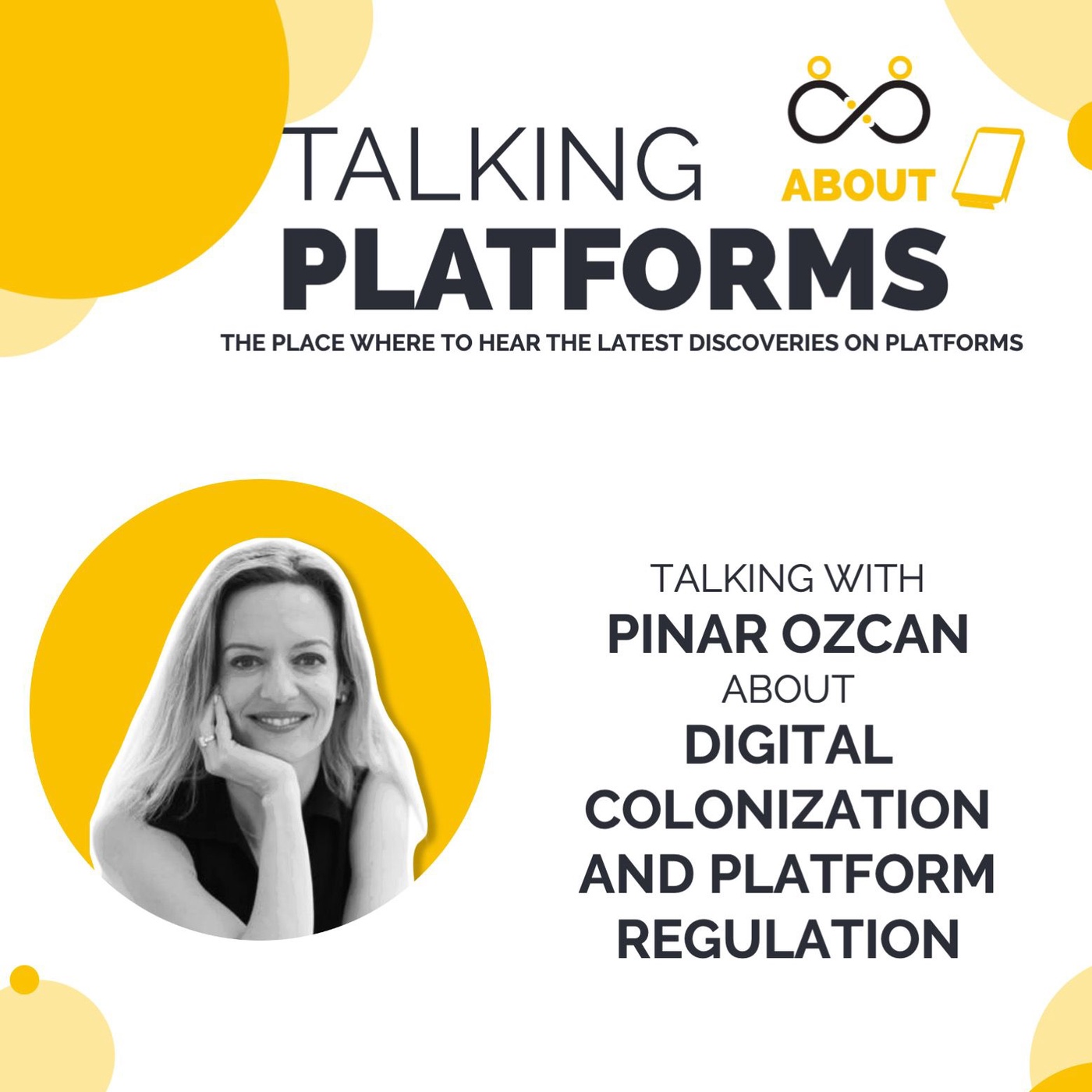
Digital colonization and platform regulation with Pinar Ozcan

Digital colonization and platform regulation with Pinar Ozcan

31m 30s

Abstract from the paper we discuss with the author during the episode:

Digital platforms have disrupted many sectors but have not yet visibly transformed highly regulated industries. This study of Big Tech entry in healthcare and education explores how platforms have begun to enter highly regulated industries systematically and effectively. We present a 4-stage process model of platform entry, which we term as “digital colonization”: (1) provision of data infrastructure services to regulated incumbents; (2) data capture in the highly regulated industry; (3) provision of data-driven insights; (4) design and commercialization of new products and services. We clarify platforms’ sources...

Blockchain-enabled platforms with Tommaso Buganza and Antonella Moretto

Blockchain-enabled platforms with Tommaso Buganza and Antonella Moretto

33m 8s

Abstract from the paper we discuss with the author during the episode:

The importance of platform‐based businesses in the modern economy is growing continuously and becoming increasingly relevant. Specifically, the deployment of digital technologies has enhanced the applicability of two‐sided business models, enabling companies to act not just as builders and owners of assets, but as orchestrators of external resources. Management research has therefore focused increasingly on the unique aspects of this model. At the center of a two‐sided platform there is a platform provider that enables a transaction between the sides, reducing the relative transaction costs. However, in recent...

The impact and the future of platforms with Martin F. Kenney and John Zysman

The impact and the future of platforms with Martin F. Kenney and John Zysman

41m 16s

Abstract from the paper we discuss with the author during the episode:

Online platforms are pervasive and powerful in today's economy. We explore the increased centrality of platforms in two ways. First, we measure the extent to which platforms are insinuating themselves into the economy. We accomplish this by analyzing the presence of platforms as intermediating organizations across all US service industries at the six-digit North American Industry Classification System (NAICS) code level. Our results show that 70% of service industries, representing over 5.2 million establishments, are potentially affected by one or more platforms. Second, we undertake a detailed firm-level...

Algorithmic management and platforms with Mareike Möhlmann

Algorithmic management and platforms with Mareike Möhlmann

36m 37s

Abstract from the paper we discuss with the author during the episode:

Online labor platforms (OLPs) can use algorithms along two dimensions: matching and control. While previous research has paid considerable attention to how OLPs optimize matching and accommodate market needs, OLPs can also employ algorithms to monitor and tightly control platform work. In this paper, we examine the nature of platform work on OLPs, and the role of algorithmic management in organizing how such work is conducted. Using a qualitative study of Uber drivers’ perceptions, supplemented by interviews with Uber executives and engineers, we present a grounded theory that...

Platform boundaries with Annabelle Gawer

Platform boundaries with Annabelle Gawer

51m 20s

Abstract from the paper we discuss with the author during the episode

This article explores what factors drive digital platform firms to set or modify their boundaries. Building on economics, strategic management, and information systems research, I suggest that digital platforms make strategic decisions over three distinct types of interrelated boundaries: (1) the scope of the platform firm (what assets are owned, what labor is employed, and what activities are performed by the firm), (2) the configuration and composition of the platform's sides (which distinct groups of customers have access to the platform), and (3) the digital interfaces (that specify...

Platforms as market orchestrators with Joost Rietveld

Platforms as market orchestrators with Joost Rietveld

39m 53s

Abstract from the paper we discuss with the author during the episode

We study how a multisided platform’s decision to certify a subset of its complementors affects those complementors and ultimately the platform itself. Kiva, a microfinance platform, introduced a social performance badging program in December 2011. The badging program appears to have been beneficial to Kiva—it led to more borrowers, lenders, total funding, and amount of funding per lender. To better understand the mechanisms behind this performance increase, we study how the badging program changed the bundle of products offered by Kiva’s complementors. We find that Kiva’s certification leads...

Piracy in the age of platforms with Milan Miric

Piracy in the age of platforms with Milan Miric

48m 1s

Abstract from the paper we discuss with the author during the episode

Research Summary
With the growth of digital platforms, understanding the role of property rights on those platforms has become increasingly important. Digital piracy, the unauthorized copying and distribution of digital products, is therefore an important strategic issue, both because of lost revenues and because it is thought to decrease innovation. Yet, while the latter effect is often argued, empirical evidence is limited. We study whether piracy affects innovation and whether it leads firms to shift to different types of innovations. By studying a large piracy event in a...